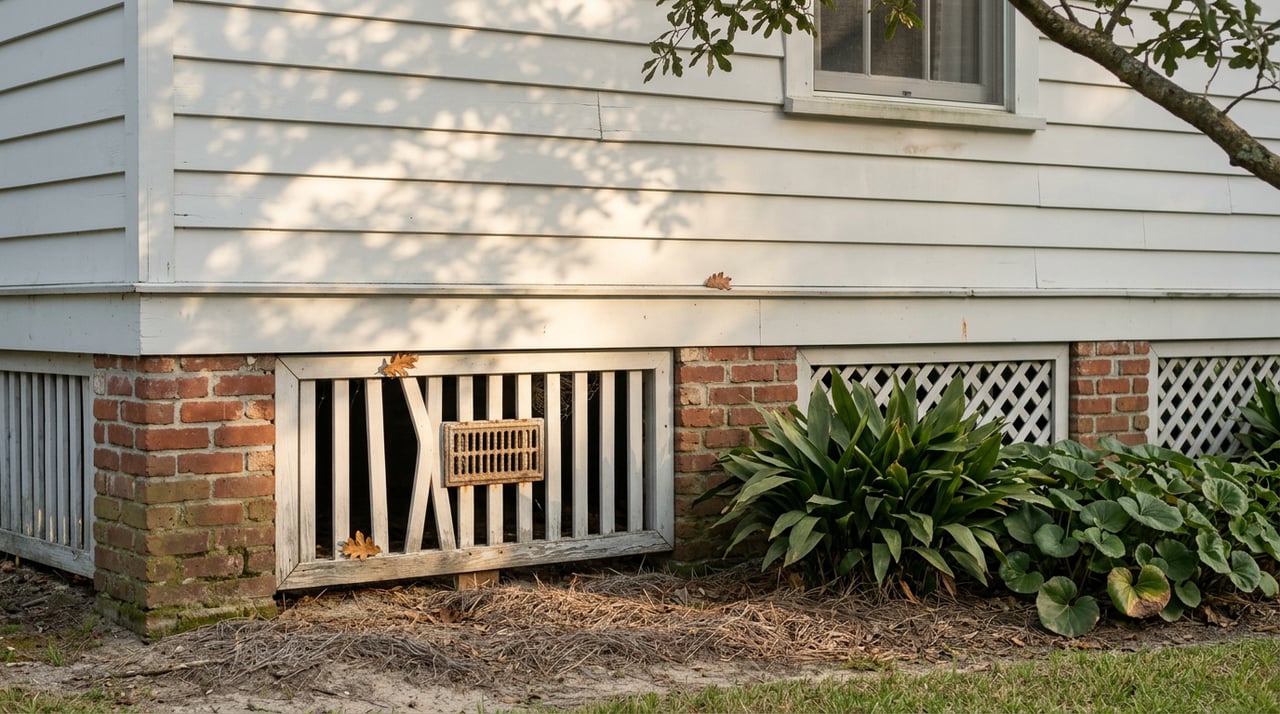
Ask a Milton seller what they're bracing for before closing and most will say the same thing: the buyer's home inspector, walking the attic with a flashlight, looking for the one repair that blows up the deal. That's rarely where Milton sales actually get renegotiated. The document that moves price, delays a closing date, or ends a transaction outright is a separate, one-page state form that most sellers have never heard of until their agent brings it up: the Wood-Destroying Organism report, known around here as the WDO or the termite letter.
A Different Inspector, a Different Form
Florida treats the general home inspection and the WDO inspection as two separate jobs performed by two separately licensed people. A standard home inspector working under industry Standards of Practice can note that wood looks damaged, but under Florida Department of Agriculture guidance, that inspector cannot state the damage is caused by termites or another wood-destroying organism. Diagnosing that requires a separate inspector carrying a state pest control identification card. The report they produce is a legal document with a specific definition: a WDO report is required whenever a home is being sold and the lender or buyer asks for it.
For a large share of Milton buyers, that request isn't optional. Maverick Inspections says FHA and VA loans require a WDO report before the loan can close, full stop. Given Milton's position roughly ten to fifteen minutes from NAS Whiting Field, a meaningful share of local purchase contracts run through VA financing, which means the termite letter isn't a nice-to-have add-on. It's a closing gate that has to open before the loan does.
Why Milton's Ground and River Make This More Than a Formality
Termite pressure in Northwest Florida isn't evenly distributed, and Milton sits on the higher end of it. Local pest control operators who work the area point to the same combination of factors: Milton's riverfront properties, older homes, and sandy soil make the area attractive to wood-destroying insects and moisture-loving pests, and subterranean termites are widespread across Santa Rosa County, thriving in damp soil and damaging older wooden homes near the Blackwater River. Regional termite companies serving the Panhandle go further, recommending a professional inspection at least once a year because activity levels here run high enough that annual checks aren't overkill, they're baseline maintenance.
That baseline risk isn't the same for every Milton address, though. It splits sharply depending on what kind of house you're buying.
Two Milton Housing Stocks, Two Different Exposure Levels
Downtown Milton and the adjacent village of Bagdad hold some of the oldest wood-frame construction in Santa Rosa County. The Bagdad Village Historic District, listed on the National Register of Historic Places in 1987, preserves 143 buildings along the Blackwater River, with structures dating back to 1847 built in Frame Vernacular styles the village still calls by their local names: the Bagdad Saltbox, the Four-square, the Double House, and the Shotgun House built originally to house mill workers. These are heart-pine structures a stone's throw from the river the mill once used to float logs downstream, which is exactly the moisture-and-soil combination pest professionals flag as high-risk.
Newer Milton subdivisions sit on the other end of that spectrum. Pest control companies working both markets specifically contrast historic homes near downtown Milton with newer neighborhoods like Whisper Creek and Berryhill Estates, where modern slab construction and treated framing lumber change the risk profile considerably.
Here's how that split typically plays out at the negotiating table:
| Historic Bagdad / Downtown | Newer Subdivisions (Whisper Creek, Berryhill Estates) | |
|---|---|---|
| Typical era | 1847 to early 1900s | Recent construction |
| Foundation type | Pier, crawlspace, heart pine framing | Slab, treated modern lumber |
| Proximity to Blackwater River | Often walking distance | Varies, generally farther |
| WDO report's usual role | Frequently surfaces prior or active activity, opens repair or price talks | Often comes back clean, used mainly to satisfy lender requirement |
Neither column means a home is a bad buy. It means the report carries different weight depending on which column your address falls into, and pricing a historic Bagdad home without budgeting for that reality is how sellers get surprised mid-contract.
The VA Loan Layer Raises the Stakes
Milton's affordability relative to Pace and Gulf Breeze is part of what makes it a default pick for Whiting Field families using VA financing, which PB Home Loan says requires zero down and no monthly mortgage insurance. With the typical Milton home valued around $285,000 as of early 2026, most local VA purchases sit comfortably under the 2026 Santa Rosa County VA loan limit of $832,750. That means for the majority of Milton VA buyers, the loan ceiling was never the obstacle. The WDO report is.
What the Current Price Split Is Actually Telling You
As of July 2026, Milton's median sold price sat at $304,831 against a median asking price of $333,634 across 84 active listings and 11 homes pending, with the middle half of recent sales closing between $244,900 and $378,082. That gap between asking and sold isn't sellers slashing prices across the board. It more often reflects a different mix of homes changing hands than what happens to be listed at any given moment.
Line that spread up against the housing-type split above and the picture sharpens. Recent relocation guidance for military buyers pegs Milton's historic character homes at roughly $225,000 to $425,000 depending on condition, and newer subdivision inventory at roughly $285,000 to $375,000. Those ranges overlap heavily in the middle, right around Milton's current $304,831 sold median. A historic Bagdad home and a Whisper Creek build can list at the exact same number. What separates where each one actually lands within that range, and how much room a buyer has to negotiate, often comes down to what the WDO report says.
What Actually Happens After the Report Comes Back
Pest inspectors working real estate transactions in this market generally sort findings into a few outcomes, and each one changes the conversation differently:
- Clean report, no evidence found. The transaction moves forward on schedule. This is the most common outcome for newer subdivision homes and well-maintained historic ones.
- Previous activity, already treated. The report shows past damage or treatment with no current infestation. This usually opens a conversation, not a wall, since the finding documents that a problem was addressed rather than ignored.
- Active infestation. The method depends on the home itself, since the right approach for a slab home differs from the right approach for a crawlspace, with liquid barrier treatments and bait stations serving different construction types.
A Milton buyer's real leverage point often isn't the roof or the HVAC system. It's whether the crawlspace under a nineteenth-century Bagdad saltbox shows fresh mud tubes.
For sellers of older homes, the practical move is ordering a pre-listing WDO inspection before a buyer's lender forces the timeline. Finding and treating an issue on your own schedule costs far less leverage than a buyer's inspector finding it during a thirty-day loan clock.
FAQ
Does every Milton home sale require a WDO inspection? Not every transaction. Cash sales and some conventional loans may skip it, but FHA and VA loans require it as a condition of closing, and many conventional lenders request one as standard practice in areas with known termite pressure.
Does a newer home in Whisper Creek or Berryhill Estates ever fail a WDO inspection? It can. Newer construction lowers the odds significantly, but it doesn't eliminate them, especially near tree cover or drainage issues that create moisture pockets.
Who pays for treatment if the report finds active activity? It typically gets resolved as part of the same back-and-forth as any other inspection finding.
If you're weighing a historic Bagdad property against a newer build east of downtown, or you're getting ready to list one and want to know where the termite letter might take the conversation, Williams Coastal Group can walk the specifics with you before it becomes a surprise mid-contract. Let's Connect.
This article is general information, not legal, tax or financial advice. Consult a qualified professional about your situation.