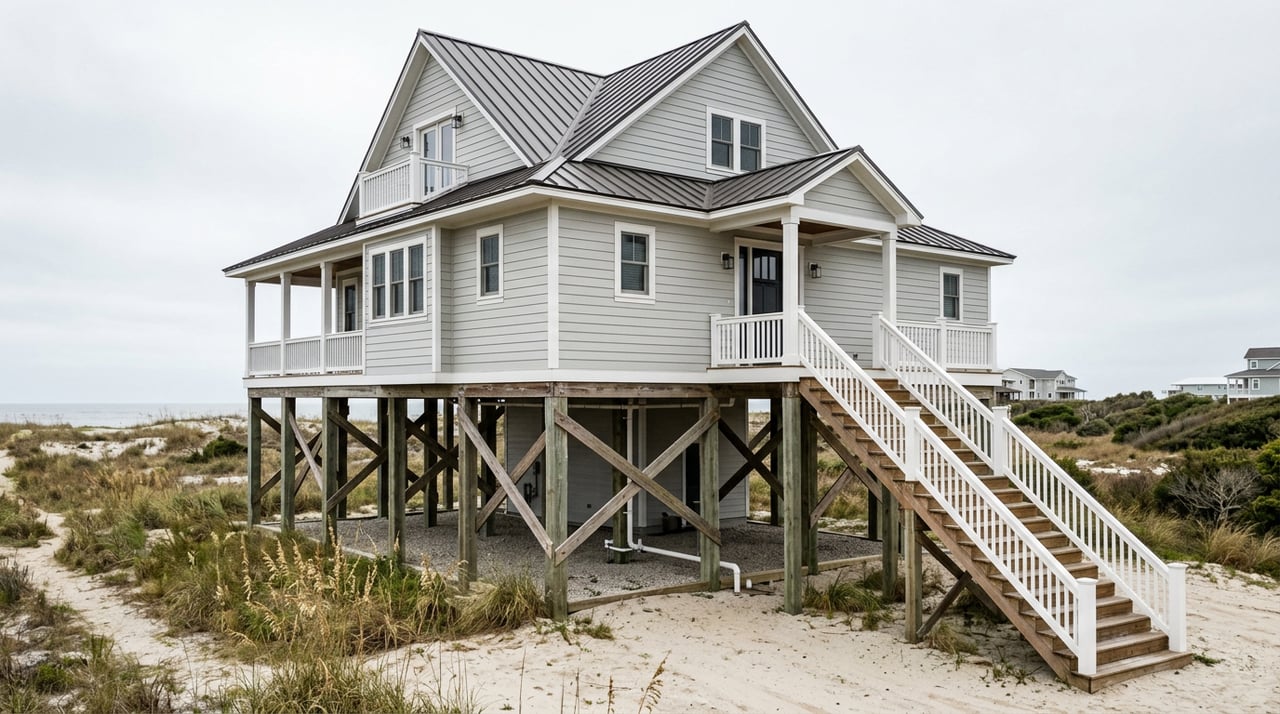
In 2023, Santa Rosa County went to rebuild a piece of Navarre Beach that had washed away. The county had FEMA disaster money lined up, a contractor ready, and a plan to place fresh sand along roughly 3.5 miles of shoreline. Then the U.S. Fish and Wildlife Service looked at where the sand was headed and said no, not there. The eastern edge of the project bordered a federally protected unit where the agency had already decided the rules were different. The county rebuilt most of the beach. It could not touch that stretch.
Most buyers never hear this story, and most never need to. But if you are looking at a specific address on Navarre Beach, the same boundary that stopped that sand can also affect whether federal flood insurance is available, and it has nothing to do with the flood zone printed on the listing sheet.
A Boundary FEMA's Flood Maps Don't Show
Navarre Beach sits on Santa Rosa Island, and part of that island falls inside the John H. Chafee Coastal Barrier Resources System, a federal designation that predates most of the flood zone conversations buyers are used to having. The system includes both System Units and Otherwise Protected Areas. On Navarre Beach specifically, the westernmost portion of the shoreline sits inside an Otherwise Protected Area known as FL-98P, which borders the Gulf Islands National Seashore, and the eastern limit of that same stretch runs adjacent to a System Unit designated FL-97.
Those unit numbers are not decoration. They are the boundary the U.S. Fish and Wildlife Service used in 2023 to tell Santa Rosa County that its own federally funded renourishment project could not place sand in that segment, because doing so ran against the purpose of the law protecting it.
The law behind both designations is the Coastal Barrier Resources Act, passed in 1982 to stop federal money from encouraging development on undeveloped, storm-exposed coastal land. It does not ban private development. It bans federal dollars from subsidizing it, and flood insurance through the National Flood Insurance Program counts as one of those dollars.
The Insurance Consequence That Shows Up at Underwriting, Not at the Open House
Here is where this stops being a conservation footnote and starts being a financing problem. The U.S. Fish and Wildlife Service says federal flood insurance inside a Coastal Barrier Resources System unit is only available if the structure was built, or permitted and under construction, before that unit's flood insurance prohibition date. If the structure does not meet that cutoff, the National Flood Insurance Program cannot write you a policy, full stop. If an already-insured structure inside the system gets substantially improved, meaning the work exceeds half the structure's market value, that policy cannot be renewed either.
CBRS status may not be flagged automatically. There is no federal requirement that a county office or a real estate agent disclose CBRS status at the time of purchase. The U.S. Fish and Wildlife Service has said as much directly, encouraging local governments to add the information to permit forms and planning documents voluntarily, which some communities have done and many have not.
That means the first time a buyer often learns their address falls inside a protected unit is when the mortgage lender's insurance search comes back empty. A buyer may need to seek private flood coverage, adjust the closing timeline, or reconsider the purchase.
Where the Line Actually Falls, Parcel by Parcel
This is not a blanket problem for everyone who buys on Navarre Beach. The island's roughly four-mile stretch is not uniform, and neither is the boundary.
The segment running from the Navarre Beach Fishing Pier, a 1,545-foot span, westward to a reference point known as R-192 is dense with hotels, condominiums, and timeshares. From R-192, the shoreline shifts to single-family homes running toward R-204, and it is near that R-192 line, at the restoration project's eastern edge, where the CBRS System Unit sits. Keep going west past R-204, toward the Gulf Islands National Seashore, and the shoreline enters the separate Otherwise Protected Area. The two federal designations bracket the island from opposite ends of that same project, not from a single corner of it.
That distinction matters for how you shop. A high-rise condo near the pier and a single-family home a mile down the beach toward the national seashore are not carrying the same federal insurance exposure just because they share a zip code and a view of the Gulf. The Coastal Barrier Resources System does not care about your building type or your association fees. It cares about which side of a mapped line your structure sits on, and whether an undeveloped portion of your lot happens to be included in the system while your actual insurable structure is not. If the structure sits entirely outside the unit even when part of the land is inside it, federal insurance is still available for that structure. It is a distinction worth documenting, not assuming.
What to Ask Before You Write the Offer
The fix here is sequencing, not paperwork. Everything below is easier before you are under contract than after.
- Ask your agent or title company to run the address through the official Coastal Barrier Resources System mapper before you make an offer, not after you're in underwriting.
- Ask when the structure was built or permitted and under construction, and whether it has been substantially improved, since those details can affect eligibility and renewal.
- Ask your lender directly whether they will accept a private flood policy if the National Flood Insurance Program cannot write one for that address.
- If part of the lot falls inside the system but the home itself does not, request documentation showing where the insurable structure sits relative to the boundary. That documentation can protect your financing later.
None of this replaces a home inspection or a wind mitigation report. It runs alongside them, and on this stretch of coastline, it can decide whether your financing closes on schedule.
One More Federal Layer Stacked on an Already Complicated Lease
Navarre Beach buyers already carry more due diligence than most coastal purchases, and the Coastal Barrier Resources System designation is one more piece stacked on a structure that was unusual to begin with. Since 1956, Escambia County has leased Santa Rosa Island, including Navarre Beach, to Santa Rosa County under a 99-year agreement, and the county in turn sub-leases individual parcels to owners, according to Pensapedia. Buyers own the home or unit, not the land beneath it. A 2014 Florida Supreme Court ruling settled that leaseholders still owe county property taxes despite not holding fee simple title.
That land tenure question and the flood insurance question are separate legal issues, decided by different bodies for different reasons, but they land on the same buyer at the same closing table. Knowing your lease terms does not tell you your CBRS status, and knowing your CBRS status does not tell you your remaining lease term. Both need their own check.
A Few Questions Worth Asking Directly
Does this mean I can't buy on this stretch of Navarre Beach? No. It means the property needs a specific check before you write an offer, and if the National Flood Insurance Program cannot cover it, you will likely need a private flood policy instead, which changes your underwriting timeline but does not eliminate your options.
How do I find out if a specific address is inside the system? The U.S. Fish and Wildlife Service maintains a public mapper and validation tool built for exactly this purpose, and it is meant to be used by property owners, agents, and insurance professionals before a transaction, not after.
Is this the same issue as the beach lease? No. The lease determines who owns the land under your home. The Coastal Barrier Resources System determines whether federal flood insurance can exist for that home at all. Both deserve a separate conversation with your agent before you commit.
If you are comparing specific addresses along Navarre Beach and want to know where this boundary falls before you write an offer, that is exactly the kind of check Courtney Williams | Florida Realtor walks through with buyers as part of every contract strategy on the island. Let's connect before you're three weeks from closing and finding out the hard way.
This article is general information, not legal, tax or financial advice. Consult a qualified professional about your situation.