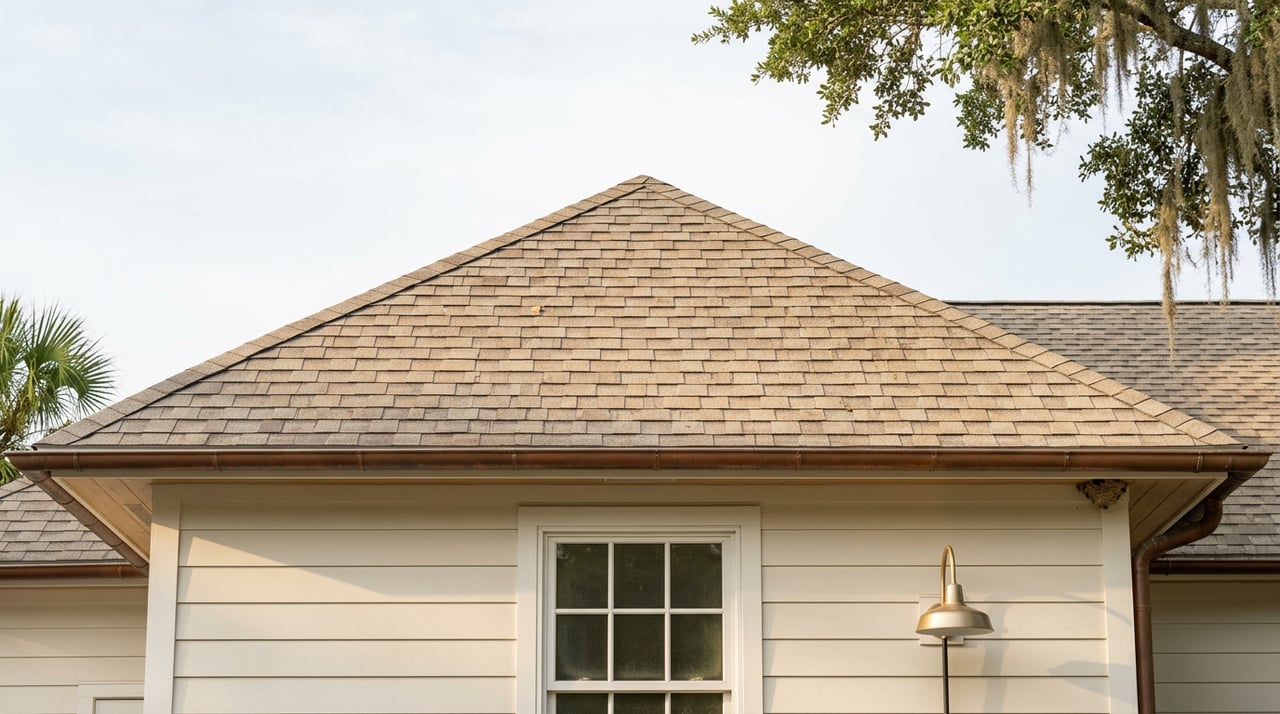
A Navarre listing usually survives the general home inspection. Buyers expect a punch list of caulk, GFCI outlets, a soft spot on a deck board. What buyers, and a surprising number of sellers, do not expect is the second inspection that quietly runs alongside it, and the one line on that second report that has more power over the closing table than anything the home inspector wrote.
That report is the 4-point. That line is the roof. And in Navarre in 2026, whether your sale closes on the original terms is being decided less by the buyer's inspector and more by the age stamped on a bundle of shingles.
The document that actually decides the deal
A 4-point is not a home inspection. It is an underwriting document the insurance carrier requires before it will bind a policy on the buyer's loan. It looks at four systems: roofing, electrical, plumbing, and HVAC, and in Florida most insurance companies require it for homes 20 years old or older, though some carriers have pushed the trigger back to 25 or 30 years while others have moved it in the opposite direction.
The cost is small. A standalone 4-point runs $75 to $150 in most Florida markets, a wind mitigation inspection runs about the same, and ordered together they typically cost less than two standalone reports. The consequences are not small. The roof is the most common reason Florida homes fail, and a failed roof section can mean no coverage at all, a stalled closing, or a scramble to find a carrier that will take the risk at a much higher premium.
If the buyer cannot get the home insured, the buyer cannot get the loan funded. The general home inspection can be perfect. It does not matter.
Two roofs, two decades, one Navarre street
Mainland Navarre's housing stock is remarkably consistent. As one longtime local roofer describes it, mainland Navarre construction is mostly 1990s through 2010s residential, with architectural shingle on truss-built roofs and current-code framing on anything post-2002. That consistency is why Holley by the Sea sees replacement cycles that cluster, with several homes on the same block sometimes getting new roofs in the same season.
Two hurricanes did most of the sorting. Ivan in 2004 and Sally in 2020 both drove waves of roof replacements across Navarre and Gulf Breeze. That means the Navarre roof you are underwriting in 2026 usually falls into one of two cohorts:
- The Ivan cohort, replaced roughly 20 to 21 years ago. Architectural shingle with a 25 or 30-year manufacturer rating, sitting at or just past the age where most Florida carriers stop writing new business.
- The Sally cohort, replaced roughly 5 to 6 years ago. Comfortably inside every carrier's window, and often eligible for meaningful wind mitigation credits if the paperwork was preserved.
Two houses on the same Holley by the Sea cul-de-sac, built the same year by the same builder, can now sit on opposite sides of the insurability line. Only the closing tells you which.
What the roof line of the 4-point actually asks
The roof section is a short list of pointed questions the inspector answers with photographs. If you are selling, these are the answers underwriters will read before they decide whether to quote your buyer:
- Age and material. Asphalt shingle is the Navarre norm. A shingle roof past 19 years is a hard stop at most carriers, with some cutoffs as low as 12 or 15 years, while tile and metal roofs get more runway, typically up to 40 years.
- Remaining useful life. Under Florida Statute 627.7011, carriers cannot deny coverage on roof age alone if an authorized inspector confirms five or more years of remaining useful life. That certification is a specific report, not an opinion.
- Visible condition. Active leaks, missing shingles, or heavy granule loss are automatic declinations at nearly every company.
- Documentation of prior work. Permits, invoices, wind mitigation form OIR-B1-1802. If it is not documented, the underwriter treats it as if it did not happen.
The 2026 shift is real but selective. Some carriers are now writing homes with older roofs using limited water coverage or an ACV roof endorsement, meaning they will cover the roof at depreciated value rather than full replacement cost. That option keeps a deal alive. It also gives the buyer a legitimate reason to reopen price.
The Santa Rosa County piece out-of-market buyers miss
Navarre is unincorporated. That single fact shapes more of the transaction than most relocating buyers realize. All roofing permits go through Santa Rosa County's building department, the county is generally responsive when paperwork is right, and pulling, posting, and closing out the permit is not optional. A contractor who suggests skipping it on a Navarre job should not be hired.
A roof replaced without a closed permit is a roof the underwriter cannot verify. Even a beautiful new shingle install performed by a licensed crew becomes a problem if the permit was never finaled with the county. Sellers who inherited a house, or who used an out-of-area contractor a decade ago, sometimes discover this only when the buyer's insurance quote comes back declined.
The fix is often clerical, not structural. A licensed roofer can help re-open and close out an old permit, and the paperwork can catch up before the closing date. It just takes time the contract may not have budgeted for.
Where the current Navarre market changes the leverage
A 4-point finding lands differently in a slow market than in a fast one, and Navarre in mid-2026 is slower than it has been in years. Zillow's ZHVI put the average Navarre home value at $418,327 as of May 31, 2026, with homes going to pending in roughly 27 days. Movoto's July 2026 read had the median list price at $464K and days on market at 59, up sharply from a year earlier. Redfin's most recent monthly cut, from late 2025, showed median sale prices around $395K and days on market near 90.
The three trackers disagree on the exact numbers because they measure different slices of the market, and that disagreement is itself the story: inventory is sitting long enough that buyers have time to be careful. When a buyer's 4-point flags the roof, a 2022 buyer might have waived the concern to keep the contract. A 2026 buyer asks for a full replacement credit or walks. Sellers who priced against last year's speed are the ones most surprised when the ask lands.
The Navarre seller who wins in 2026 is the one who orders the 4-point and wind mit before the sign goes in the yard, not the one who finds out about the roof from the buyer's underwriter.
The pre-list move that changes the math
Getting ahead of the roof line is not complicated. It is a matter of sequence.
A pre-listing 4-point and wind mitigation inspection, run together, gives a Navarre seller three usable pieces of information before the first showing. First, whether the roof passes at all. Second, if it does not, whether a documented repair by a licensed roofer will satisfy the form, because localized findings usually satisfy the carrier with a targeted repair and a re-check, while a roof past its expected service life will not accept spot repairs because the age math still fails. Third, what wind mitigation credits are already on the house. Post-Ivan and post-Sally rebuild work often qualifies for meaningful premium credits if it is documented correctly, and that is the part many homeowners miss when they have not had a current inspection done.
Navarre-based inspectors handle both forms routinely. POMI Services, based in Navarre, and WIN Home Inspection, which covers Navarre, Milton, and Fort Walton Beach, are two of the local options for buyers and sellers who want a clean, photographed report the underwriter will accept. Local roofing companies that pull Santa Rosa County permits and document wind-mit-eligible work include Buckworth Roofing, Whitrock Associates, Complete Roofing, H&R Roofing & Construction, and Tadlock Roofing. Pricing an accurate credit into the list price is a very different conversation than negotiating a credit into the closing statement.
If a full replacement is the honest answer, that changes the listing strategy rather than ending it. A new roof to current Florida Building Code resets the age clock for the 4-point, typically improves the wind mitigation report at the same time, and takes the non-renewal target off the owner's back for years. Done before listing, the cost is a line item in the seller's net sheet. Done under a signed contract, it is a leverage point for the buyer.
FAQ
Does the buyer's home inspector run the 4-point? Not typically. The 4-point and wind mitigation are usually done together but separately from the general home inspection. The 4-point tells the carrier whether the home's four systems are insurable, and the wind mitigation documents the wind-resistance features that earn premium discounts. One protects coverage; the other lowers its cost.
What if the roof is 18 years old but looks fine? Condition and age are weighed together. A well-maintained 18-year-old roof can pass while a neglected 12-year-old roof fails. The safer path in 2026 is a written remaining-useful-life certification under Florida Statute 627.7011 before the house goes live.
How fast can a flagged roof be fixed inside a contract? Localized findings like cracked tiles, missing shingles, or flashing details are often repaired within the same week. Full replacements depend on permit timing through the municipality, typically 1 to 3 weeks before install, with the install itself usually 2 to 4 days. In Navarre, that municipality is Santa Rosa County.
Ready to price the roof, not around it
The Navarre houses selling closest to list price this summer are the ones whose sellers already know what the 4-point will say. If you are thinking about listing in Navarre or Holley by the Sea and are not sure which cohort your roof falls into, that is the conversation to have before the sign goes in the yard. Williams Coastal Group can walk your home the way an underwriter will, connect you with the local inspectors and roofers who handle these files every week, and build the pricing strategy around what the paperwork actually shows.
Let's Connect.